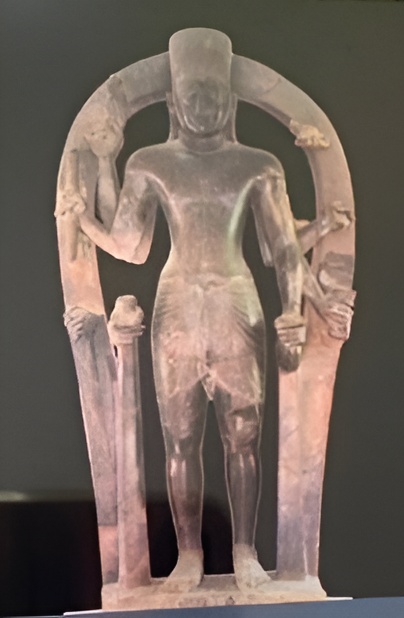
“This is a sandstone statue of an eight-armed Vishnu. It originated from Phnom Da, Angkor Borey District, Takeo Province. It is part of the collection of the National Museum of Cambodia. Experts of Khmer art have determined that it belongs to the Phnom Da style, of the 6th century, Pre-Angkor era. The Phnom Da style is the oldest in Khmer art.
Experts have classified 14 styles based on characteristics of decorative architecture: Lintel, column, pediment, single sculpture and others. However, sculptural form is still a key element for classification.Henri Mauget discovered this eight-armed gigantic Vishnu statue during an archaeological excavation at Phnom Da in 1936.
It was opposide of 12th-century temple that was built near another temple constructed in 6th century. At that same side, he also found statues of Rama and Balarama next to each other. Unlike other statues from the area that show reclining postures, this Vishnu statue stands erect, projecting both handsomeness and might. Art experts and researchers identify this statue as a triad of Phnom Da style, which all of collection of the National Museum. It is a combination of three figures: the eight-armed Vishnu in the middle, Rama on the right and Balarama on the left. It is believed that this statue was sculpted by one person or at least under the supervision of one sculptor.
One of the characteristics of pre-Angkorian sculptures, especially from Phnom Da, is the use of a horseshoe-shaped arch to connect with the base as a stabilizing mechanism. Such a mechanism was necessary for large statues that were sculpted to portrait movement. The Phnom Da style was strongly influenced by Indian Gupta art, which is characterized by an oval facial form and the curved sharp nose, that differentiate thinnns statue from the facial feature of the Funan people, who wore braided hair falling down over the neck.
Phnom Da was a major hub of Vishnu worship, while the influence of Shiva was also present at the same time. This eight hand Vishnu statue is considered to be among largest statues in the history of Khmer sculpture.
This Vishnu sculpted in a way to projected the almighty power of a supreme deity governing the universe. All eight hands hold attributes that have different form due to Indian influences. The head wears a cylinder like crown that avoid any the decorate caving. The face is in an oval-shaped with junior curved and pointed nose, arched eyebrows, and large lips. Some of the recognizable attributes are the flame, animal skin, and vase which are rare for either Vishnu or Shiva to hold. A 12th-century inscribe stone during the reign of King Suryavarman II, who ordered construction of Angkor Wat, describe the construction of the Hari Kampuchea Chendra statue, Hari is another name for Vishnu that can be a interpreted as the master of Cambodia. Which researchers believe to be the gigantic Vishnu statue at Phnom Da itself./.”