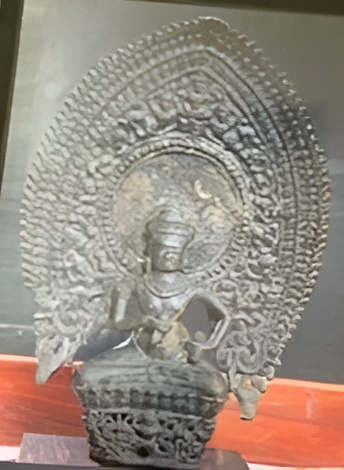
“This object is a bronze of Vajrapani. This object is currently part of the collection of the National Museum of Cambodia. Although its origin is still unclear, Khmer art experts to have examine to design them, have determine that it belongs to the Bayon style of the late 12th and early 13th centuries under the reign of King Jayavaraman VII, from year 1181 to 1218 CE. He sits cross-legged on a pedestal supported by a lotus flower and a lion. He has a slim body, and the facial shape that suit well with the shape of the crown of his head. His ears are long and adorned with long lotus petals earings, that almost touched his shoulders. He also wears a neckband and a bracelet on his wrist.
His hands hold two Vajras, one at his waist and another at his chest. This is a characteristic of Angkorian-period art. Behind this back is a nimbus with engraved bodhi leaves motifs, and a circle in the center surrounded by nimbly pierced floral motifs. Vajrapani is meditating in the company of heaven beings.
It likely that Vajrapani was used as a decorative item for carriage, for card, in homage to Mahayana Buddhism during the Angkorian period.”