
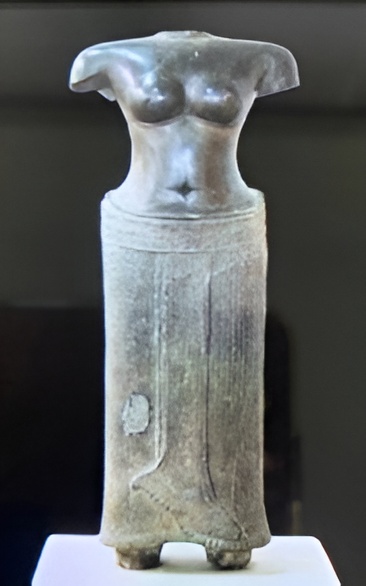
This work is a sandstone Female Divinity. It originated from the Angkor monument group, but it is still unclear in which temple it originally stood. The statue was taken it for safekeeping and registered into the collection of the National Museum of Cambodia in 1923.
Khmer art experts determine it is in the Angkor Wat style, in the 12th century Angkorian period, during the reign of King Suriya Burman II, from the year 1113 to 1150 CE. This statue has suffered a great deal of damage.
The head is missing, both hands are broken at the forearms, and the feet are also broken at the ankles. Despite the damage, the statue remains an elegant masterpiece. She wears a Sampot and a small pleated Samlouy that it tied under the belt.
The Sampot has a moon flower decoration and leave a long hem and the shaped of fishtail in the front. Left dangling on the Samlouy, is a rich that is decorated with the style of tiny lotus petal and fish eggs. These are popular characteristics of the Angkor style. In the early years after its discovery, this statue was exhibited at the Louis Phinot Museum in Hanoi, Vietnam, before being transferred to the National Museum in Cambodia in 1954.