
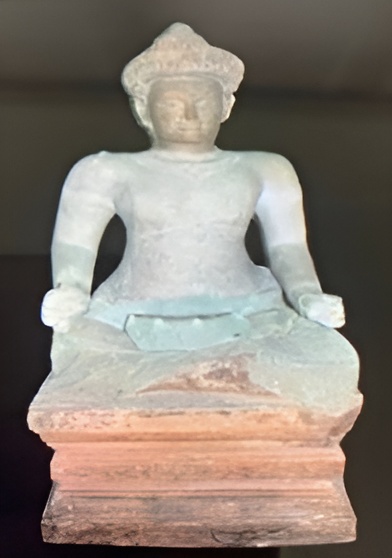
This is a statue of Balarama made of sandstone. It originated from the western gate of Prasat-Chen, Koh Ker, in Kulen district, Preah Vihear province. The statue was looted from western gate Prasat Chen, Koh Ker and was later rediscovered 1970. In 1990, it was seen for first time, being put on sale at an antique black market named Spinksand in London, United Kingdom.
Later, in 2009, it emerged at an auction by the art deal company, Christie’s in New York. On 31 of May 2014, Christie’s returned this work to Cambodia, where it was immediately entered into the collection of the National Museum of Cambodia. Khmer art experts conclude it is in the Koh Ker style, of the first half of the 10th century, Angkorian period, under the reign of King Jayavarman IV, from the year 921 to 941 CE.
This statue was originally constructed from one stone block, which was later broken into seven pieces. Here, Balarama sits cross-legged on a three-tiered square pedestal, which is bare of any carve elements. his hands stretched forward and holds as his attribute a plow. The face features a smile, and the mustache and beard that is recognizable by the dots from one side of his chin to the other.
His head wears a diadem and a crown, which has five tiers and carving of split petal and fish-egg motifs. The face bear resembles that of Pandava. For lower part of his body wears a pleated sampot chong Kben which has a fringe that look like fishtail at the back. It is tucked under a belt. The upper part of the body is bare. The statue wears cross-chest armbands, bracelets, and a neckband as part of the decoration.
Balarama is the Plow holding god and the older brother of the god Krishna, who is an avatar of Vishnu. In the Mahabharata the story, Balarama was neutral and did not take site with either the Kaurava and Pandava clans. He taught both Bhima and Duryodhana, who were life-and-death enemies, how to fight using sticks.
In the battle, Bhima broke Duryodhana’s thigh in violation of the combat rules that prevented the fighter from hitting each other below the navel. Balarama was so outraged when he witnessed the unlawful act committed by Bhima and wanted to punish him, but Balarama’s younger brother, Krishna, prevented him from this act. Krishna wanted Bhima to remember the promise to break Duryodhana’s leg that he had made before the fight. If you would like to learn more about the history of the repatriation of Koh Ker statues to Cambodia.
“