
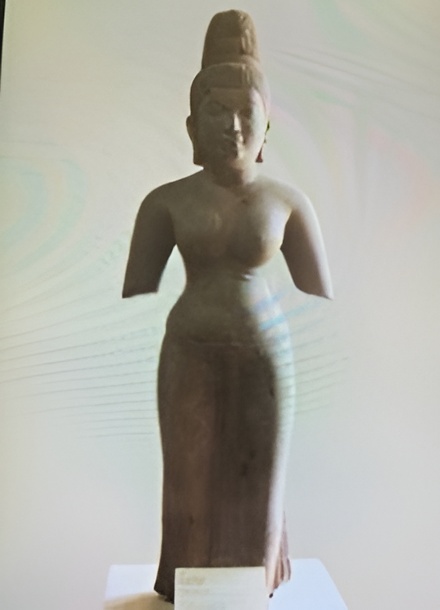
This is a sandstone statue of Harihara. It originated from Phnom Da Angkor Ba Ray District, Takeo province. It is in Phnom Da style of the 6th century pre-Angkorian era. In 1944, this statue entered the collection of the National Museum of Cambodia without the head which in 1886 had already been taken to France. Harihara is a composite work depicting the figures of Vishnu and Shiva fused into one. Vishnu is on the left and Shiva on the right. Each of them can be recognized by their respective attributes. For example, Shiva can be recognized by a dangling festoon of hair and the crescent shape on the forehead, which is half of his third eye. On the left is Vishnu, who can be recognized by the haft-cylindrical crown on his head. This statue serves as a model of the Phnom Da style, where one of the garments, the Sampot has a folded resting on the left thigh with two overlapping fishtail-line ends. It hangs on the waist line from a tiny belt knotted oval-shaped. At the back, there is a support section in a horseshoe-shaped that attaches to the base to provide stability. This statue is missing its head which is currently on display at the Guimet Museum in Paris. The head was removed from the Ashrom Moharusei temple near Phnom Da. This statue exhibits a slender figure and is not as monumental as the statue of the eight- armed of Vishnu from the same location. Both upper arms are missing and only the two lower arms remain. The left lower arm holds the club which is an attribute of Vishnu. The right lower arm holds bits an attributed to Shiva. Before it was broken, the left upper arms of Vishnu held a Chakra or a mythical dish of power. Similarly, the upper right arm before it was served held a trident an attributed of Shiva. Harihara, was widely worshipped in the Pre-Angkorien period. Like other Phnom Da statues, it received strong influence from Indian Gupta of art, that characterizes the oval face of the shapes white jaw, curved eyebrows and dot a rounding the edges of the eyes. If you wish to learn more details about the history of this statue in relation to the museum in France, please press number 406 button and then press play button.