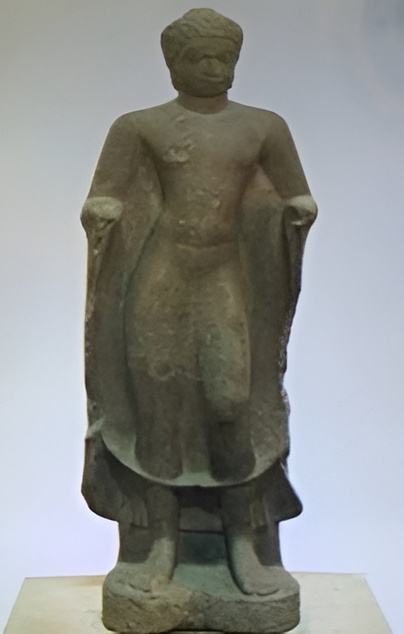
This is a Buddha make from sandstone. It originated from Wat Rumlok, previously in Prey Kabbas district, but now in Angkor Borei district, Takeo province. It is currently in the collection of the National Museum of Cambodia. Experts have concluded that it belongs to the Phnom Da style and was sculpted in the pre- Angkorian era, of 6th century, during the reign of King Rudrawarman.
According to the records of the Southern Qi and Leng Dynasties in China, a delegation of Buddhist monks from the Funan Kingdom presented tributes and gifts of an ivory stupa and called coral Buddha statue to the Chinese emperor during such visits in the years 484 and 503. These gifts signified that Buddhism had already established its presence in the Funan Kingdom, where Brahmanism was the dominant religion at the time.
In this work, Buddha stand on two lotus flowers, with the characteristic of Amravati art. Buddha in a modest stance, is a common feature of statues that originate from the Angkor Ba Ray region. His robe is very thin and appears to be glued to his body. Its shape can be easily seen through such a thin covering. The robe and flexion of the body are related to the Indian Gupta art of the 4th-century. His right hand may be in the Abhayá mudra, which indicate a gesture of fearlessness, and the left hand in the Varada mudra, with signifying offering, welcome, charity, giving, compassion, and sincerity, assuming the missing arm was in Abhayá mudra. This posture was highly popular in the Mon empire, named Dwaravati, that then made up a part of Myanmar in Thailand today.