
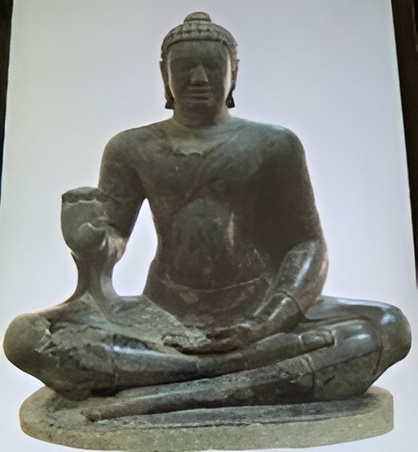
This work is Buddha in Abhayamudra, a fear defies gesture. It is made of sandstone, but was later modified by adding gold paint. The origin of this work from Kampong Luong Pagoda, Angkor Ba Ray District, in Takeo Province. In 1944 it was transferred from that location to the collection to the National Museum of Cambodia. Khmer art experts have determined that it is in the Phnom Da style, in the late 6th to 7th century of the pre-Angkorian period. The statue has been modified and coated with gold paint many times, making it impossible to conduct a thorough study or restore it to its original state. This Buddha was believed to be a statue with magical powers at Kampong Luong pagoda. He is sited on an oval pedestal. The body is a tired in a thin robe, with the right shoulder uncover. He rests his left hand on his lap, and raised is the right one in the Abhayamudra gesture. He wears a smile on his face. His head is covered shapes that depict coiled hair, and his two ears are rather large and long. The thin robe is tight allowing the body to be seen through it, reflecting the ancient natural trend other supply to produce a statue that resembled a human being.