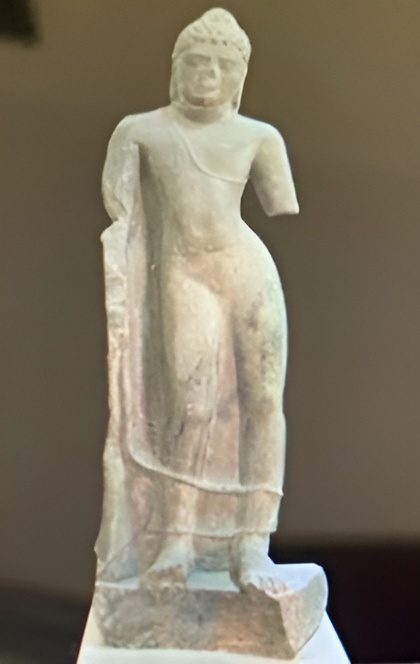
This is a standing sandstone Buddha. It originated from Romlok Pagoda, in Prey Kabbas district, Takeo Province. It is in the Phnom Da style and of the 6th century, pre-Angkorian era Georges Crullier brought it to the collection of National Museum in 1923. This object is among the oldest Buddha statues discovered in Cambodia and the Mekong Delta region, that served as major trade in religious hubs of the Funan Kingdom. Like most objects of this era, it is characterized by an oval face, broad jaw, curved eyebrows, and dots around the edges of both eyes. Buddha has a calm expression, which a common to other similar statues originating from Angkor Borei. The garment covering the body is very thin, that through it the whole torso is clearly visible. Along with sampot covering the lower part of the body. This attire as indication a civilized person. The body flexes in the middle, with suggests the connection with influence from the Indian Gupta art of 5th or 6th-century. It’s both arms are missing, it is difficult to determine the original gestures it is believed the right hand was in the Abellá Mudra gestures, while the left was in the Varada mudra, similar to the other work from the Rumlok pagoda with catalog number KA 1589.