
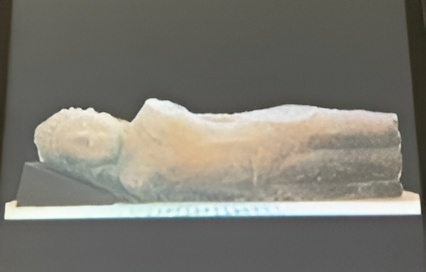
This is a sandstone statue of Buddha attaining Nirvana. It originated from Angkor Ba Ray, Angkor Ba Ray district, Takeo Province. This sculpture was discovered in the Angkor Ba Ray River, and later entered the collection of the National Museum of Cambodia in 1944. Analysis of its design characteristics suggests that this statue was carved in the Phnom Da style of the 6th century, pre- Angkorian era. This statue has suffered serious erosion, after being buried under the riverbed for a considerable of time. A sculpture of Buddha attaining Nirvana is an indication that Mahayana Buddhism established its presence in Cambodia a long time ago, with its center being at Angkor Ba Ray itself. The statue bears a smiling and lively face. The hair is braided and the ears long. The modest expression is a common feature that can be found on other Buddha statues from the Angkor Ba Ray region. The sculpture depicted a very thin cloth which shows clearly the shape of the body beneath suggesting the illumination emanating from its form that underlies his knowledge. Attaining Nirvana meant he was no longer in the birth and death cycle. The sculpture received influence from Indian art of the Gupta period, from the 4th century CE.