
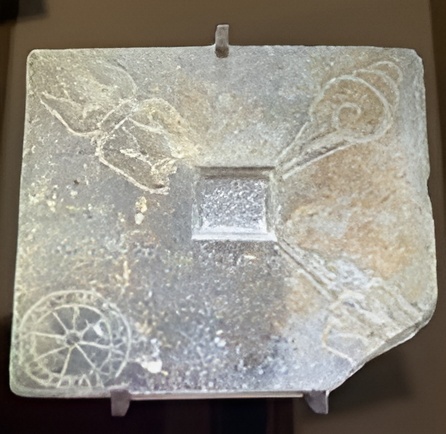
This is a sandstone inscription decorated with divine attributes. Its origin is unclear, but most likely it originated from Phnom Da, Angkor Ba Ray District, Takeo Province. From there, it entered the collection of the National Museum of Cambodia. According to Khmer art experts who have studied its characteristics, this inscription was made in the 6th or 7th century of the pre-Angkorian period. This inscription is quite unusual and the only one which was discovered at a pagoda near Phnom Da, Takeo Province, in 1990. It has one line of Sanskrit that pay respect to an ascetic named Chayamini and similarly to sacred thunder. Chaymini was the name of the knowledgeable Indian hermit. This name is also inscribed on stones number K609 and KA442. Beside the inscription, the stone has other engravings of divine attributes on its four corners. These attributes are Vajra, Conch, Trident, and Chakra. Chakra and the conch are two well-known attributes of Vishnu. As for Vajra, it is an attribute of Indra, but it could also be an attribute of Shiva. These engravings may also represent the attributes of Harihara, which is the combined form of both Shiva and Vishnu.