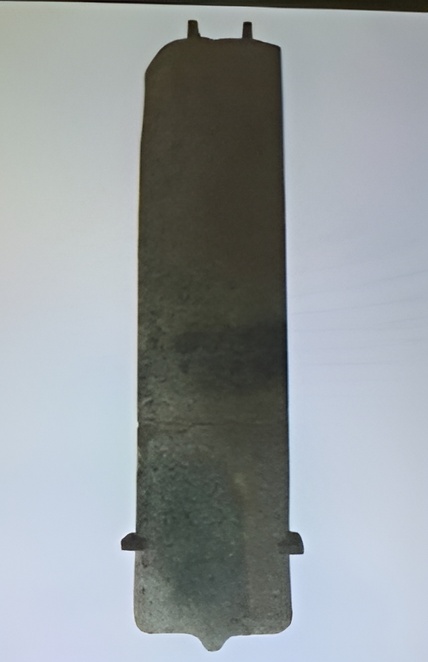
This is a sandstone inscribed Stela. It originated from Tuol Ku Hearh in Kandal Province, from where it was taken to enter the collection of the National Museum of Cambodia. Inscription expert has determined this Stela was inscribed during 7th century Chenla period prior to the Angkorian era. The Stela consists of two portions that was found nearly three decades apart from each other. The upper portion was discovered in 1966 and the lower one in 1990. At this time, it was not immediately known that they related to each other. Only in 2004, when art experts began making copies of the scripts, did they realize that they belonged together. The inscription on this stone is in two languages: Ancient Khmer in six lines and Sanskrit in 14 lines. The top brink of the Stela bears an image of a crescent moon which is inscribed in secret script. The script contains the words Chantreapheanuk, which means the moon ray as a tribute to the makers of the offerings to the God. It goes on to speak about the offerings that was made to Amarakesvarak. The name of Shiva divinity in the 6th and 7th centuries. Amrakeswarak is a name that was used frequently during the pre-Angkorian period. The offering including coconut and areca palm plantations, fruit tree plantations, and several servants who are care taker for this temple. This is a very high significant Stela which has inscription of 800 areca palm trees. Another important point to note is that its speech about Tuol Ku Heah site. Which is located close to Angkor Ba Ray, Takeo province. This location was a major religious help and the birth place of Khmer civilization during the Funan period.